How to Perform Umrah: Complete Step-by-Step Guide
A clear, practical walkthrough of every Umrah ritual, written for first-time pilgrims from Pakistan.
Understanding the Structure of Umrah
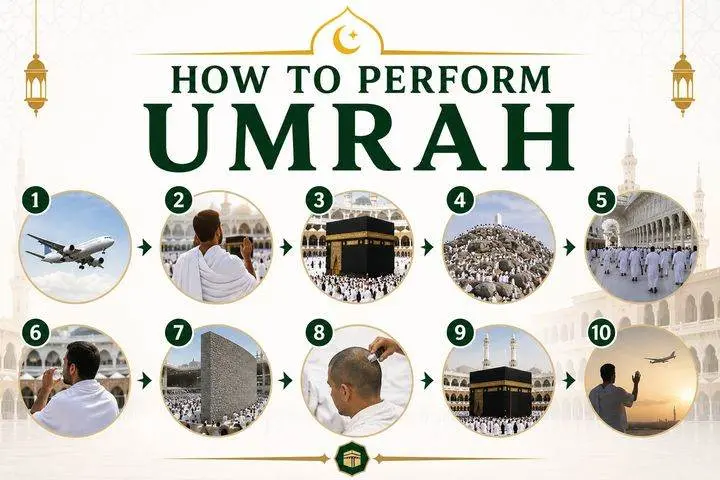
Umrah consists of a clear, defined sequence of rituals unlike Hajj, which spans several days and specific dates, Umrah can typically be completed within a few hours once you arrive in Makkah, though most pilgrims extend their trip for additional worship, rest, and Ziyarat. The core sequence is: entering the state of Ihram, performing Tawaf (circling the Kaaba), performing Sa'i (walking between Safa and Marwa), and finally Halq or Taqsir (shaving or trimming the hair). Understanding this sequence in advance removes much of the anxiety first-time pilgrims feel about "doing it wrong."
Step 1: Entering Ihram
Before reaching the Miqat (the designated boundary points around Makkah), pilgrims must enter the state of Ihram a state of spiritual purity and specific physical preparation. This involves performing ghusl (a full ritual bath), and for men, wearing two pieces of unstitched white cloth. Women wear modest, regular clothing that covers the body appropriately, with no specific color requirement, though many choose white or simple, modest garments. Before donning Ihram clothing, pilgrims typically pray two units (rakahs) of voluntary prayer, then make the intention (niyyah) for Umrah specifically, followed by reciting the Talbiyah a declaration of presence and devotion repeated throughout the journey to Makkah.
Once in Ihram, certain restrictions apply: no cutting hair or nails, no use of perfume, no marital relations, and for men specifically, no covering the head or wearing stitched clothing. These restrictions remain in place until the final stage of Umrah is completed.
Step 2: Tawaf Circling the Kaaba
Upon arriving at Masjid al-Haram, pilgrims perform Tawaf circling the Kaaba seven times in a counter-clockwise direction, starting and ending at the Black Stone (Hajar al-Aswad) corner. Each circuit is called a "shawt." Pilgrims are encouraged to touch or point toward the Black Stone at the start of each circuit if possible, though this is not obligatory, and the crowds around it mean many pilgrims simply gesture toward it from a distance rather than attempting to physically reach it, which is completely acceptable.
During Tawaf, pilgrims often recite specific duas, though there's no single mandatory recitation sincere personal supplication in any language is acceptable and encouraged. After completing the seven circuits, pilgrims pray two units of prayer, ideally near the Station of Ibrahim (Maqam Ibrahim) if space allows, or anywhere within the mosque if the area is too crowded.
Step 3: Sa'i Walking Between Safa and Marwa
Following Tawaf, pilgrims proceed to perform Sa'i walking back and forth seven times between the hills of Safa and Marwa, commemorating Hajar's search for water for her son Ismail. One full circuit from Safa to Marwa counts as one passage, with the return journey counting as the second, continuing until seven total passages are completed, ending at Marwa. The path between the two hills is now fully enclosed within the mosque complex, air-conditioned and accessible, including dedicated lanes for those using wheelchairs.
As with Tawaf, sincere personal supplication during Sa'i is encouraged, without any single mandatory recitation required.
Step 4: Halq or Taqsir Hair Cutting
The final ritual act of Umrah is hair cutting. For men, this can be either Halq (shaving the head completely) or Taqsir (trimming the hair), with Halq generally considered to carry additional reward. For women, only Taqsir applies trimming a small portion of hair, approximately the length of a fingertip, rather than shaving. Once this is completed, the restrictions of Ihram are lifted, and Umrah is considered complete.
What Happens After Umrah Is Complete
Once you've completed Halq or Taqsir, you're free from the restrictions of Ihram and can resume normal activities wearing regular clothing, using perfume, and so on. Most pilgrims spend their remaining days in Makkah continuing to pray at Haram, performing additional voluntary Tawaf if they wish, before traveling to Madina to pray at Masjid an-Nabawi and visit historical Islamic sites through Ziyarat, though visiting Madina is not a religious requirement of Umrah itself it's a deeply valued, common practice rather than an obligatory ritual step.
Common Questions First-Timers Have About the Process
Many first-time pilgrims worry about losing track of their Tawaf count amid the crowds a completely normal concern. Using a simple counter (many phones have a Tawaf counter app, or a manual tasbih counter works just as well) removes this stress entirely. Similarly, concerns about not knowing Arabic duas by heart are common but unfounded sincere supplication in Urdu, English, or any language you're comfortable with is entirely acceptable throughout every stage of Umrah.
Performing Umrah on Behalf of Someone Else
Some pilgrims choose to perform an additional Umrah on behalf of a deceased family member or someone unable to travel, which involves making the intention (niyyah) specifically for that person before beginning. This is a separate, additional Umrah typically performed during the same trip after completing one's own, following the identical ritual sequence.
Getting Practical Support During Your Umrah
While this guide covers the ritual sequence, having an experienced coordinator available during your actual trip to answer real-time questions, help navigate crowded periods, and provide reassurance if something feels confusing in the moment makes a meaningful difference, particularly for first-time pilgrims. This is precisely why we maintain WhatsApp support throughout every pilgrim's trip, not just during the booking process.
A Final Note on Approaching the Rituals
It's worth remembering that the physical steps of Umrah, while important to perform correctly, are ultimately a vehicle for something deeper sincere worship, reflection, and connection. Pilgrims who arrive overly anxious about perfecting every technical detail sometimes find themselves so focused on procedure that the spiritual dimension of the experience gets lost. Learning the steps in advance, as this guide aims to help with, is meant to free you from that anxiety during the actual journey, so your attention can remain on the deeper purpose of the pilgrimage itself.
Related Reading
Related Umrah planning: For better planning, compare how to perform Umrah step by step, review complete Umrah checklist, check Umrah packing list, and read first-time Umrah guide before confirming your booking.
Ready to Begin Your Umrah Journey?
Let us handle the logistics so you can focus on worship.
Travel information reviewed by: Muhammad Qasim, Owner | Travel Consultant: Faisal Jabbar | Operations Manager: Shakir Khan | Licensed Pakistan Tour Operator, Licence No. 9883 | Last reviewed: October 2026