Umrah vs Hajj: What's the Difference?
Understanding the religious, practical, and logistical differences between Islam's two pilgrimages.
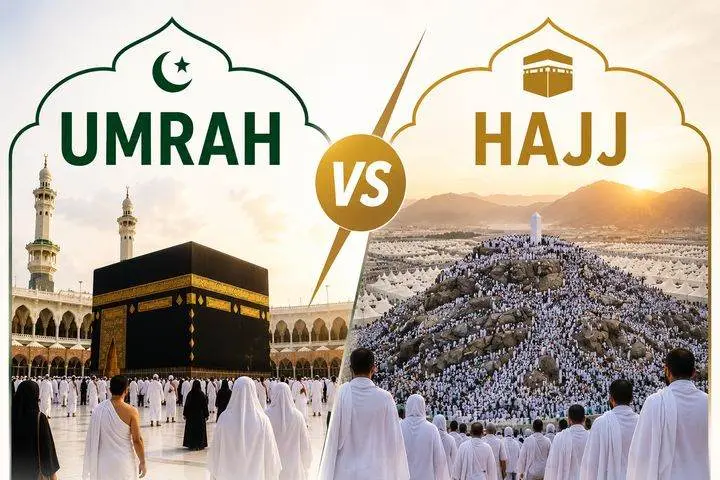
The Core Distinction
Both Umrah and Hajj involve traveling to Makkah and performing rituals centered on the Kaaba, which is why the two are sometimes confused by those less familiar with Islamic practice. The fundamental distinction is this: Hajj is one of the Five Pillars of Islam, religiously obligatory at least once in a lifetime for every Muslim who is physically and financially able, and can only be performed during a specific window of days in the Islamic month of Dhul Hijjah. Umrah, often called the "minor pilgrimage," is not obligatory, can be performed at any time of year, and involves a shorter, simpler set of rituals.
Ritual Differences
Umrah consists of four core steps: entering Ihram, performing Tawaf (circling the Kaaba seven times), performing Sa'i (walking between Safa and Marwa), and Halq or Taqsir (hair cutting). This can typically be completed within a few hours.
Hajj includes all of these elements but adds several additional rituals performed over multiple days, including standing at the plain of Arafat (considered the central pillar of Hajj), staying overnight at Muzdalifah, the symbolic stoning of the pillars at Jamarat in Mina, and an animal sacrifice (Qurbani). The entire Hajj process typically spans 5-6 days, compared to Umrah's much shorter ritual duration.
Timing Differences
This is one of the most practically significant differences for travelers. Umrah can be performed at any time throughout the year our full range of packages reflects this flexibility, with options for Ramadan, December, and any other month based on your personal schedule. Hajj, by contrast, occurs only once a year during a fixed window in Dhul Hijjah, the final month of the Islamic lunar calendar, meaning there's no flexibility in scheduling every pilgrim performing Hajj does so during the same days each year.
Religious Obligation
Hajj is one of the Five Pillars of Islam a core religious obligation for every adult Muslim who has the physical capability and financial means to undertake the journey, required at least once in a lifetime. Umrah, while highly recommended and carrying significant spiritual reward (particularly when performed during Ramadan), is not a religious obligation in the same category. Many Muslims perform Umrah multiple times throughout their lives, sometimes annually, in a way that simply isn't possible with Hajj given its fixed yearly timing and the logistics involved.
Cost and Planning Differences
Hajj typically involves significantly higher costs than Umrah, given the longer duration, the specific accommodation requirements during the Hajj days (including tent accommodation at Mina), and the overall complexity of coordinating the experience for the large number of pilgrims performing Hajj simultaneously each year. Hajj also requires advance government quota allocation in many countries, including Pakistan, meaning the booking and planning timeline for Hajj is considerably longer and more structured than for Umrah, which can often be arranged within a matter of weeks.
Which Should You Plan First?
For most Pakistani Muslims, Umrah is the more accessible starting point achievable at a lower cost, with flexible timing around work and family commitments, and without the quota and waiting-list complexities that often accompany Hajj planning. Many pilgrims perform Umrah multiple times before eventually performing Hajj, using each Umrah trip as both a meaningful spiritual journey in its own right and a way to become familiar with travel to Saudi Arabia, the general environment around the Holy Mosques, and the experience of performing pilgrimage rituals all of which can make a first Hajj experience feel less unfamiliar when the time comes.
Common Misconceptions
A common misconception is that performing Umrah multiple times somehow fulfills or substitutes for the Hajj obligation it does not. Hajj remains a separate, distinct religious obligation regardless of how many times someone has performed Umrah. Another misconception is that Umrah is religiously "lesser" or less meaningful simply because it isn't obligatory in Islamic tradition, Umrah carries substantial spiritual reward in its own right, particularly when performed during Ramadan, when its reward is described in Hadith as equivalent to performing Hajj.
Planning Your Umrah Journey
If you're ready to plan your Umrah, whether as your first pilgrimage experience or a return journey, explore our full range of packages covering every budget, duration, and travel companion configuration, or reach out via WhatsApp to discuss your specific situation directly with our team.
Can You Combine Umrah and Hajj in One Trip?
Yes pilgrims performing Hajj often also perform Umrah during the same trip, either before or after the main Hajj rituals, given that they're already in Saudi Arabia and the additional Umrah rituals require relatively little extra time. This combined approach is common and considered a valuable way to maximize the spiritual benefit of a single journey to the Holy Land, particularly given the cost and effort involved in traveling to Saudi Arabia from Pakistan.
Government Quota System for Hajj vs Umrah
One of the most significant practical differences for Pakistani pilgrims specifically is that Hajj operates under a government-managed quota system, with the Ministry of Religious Affairs allocating a limited number of spots annually through both government and approved private scheme operators, often involving a lottery or waiting-list process for private Hajj packages. Umrah has no such quota restriction any pilgrim with a valid passport, appropriate documentation, and the financial means can apply for an Umrah visa at essentially any time of year, without the multi-year waiting periods sometimes associated with Hajj quota allocation.
Spiritual Preparation: How They Differ
Many scholars and experienced pilgrims note that the spiritual preparation for Hajj tends to be more intensive, given both the religious weight of fulfilling an obligatory pillar of faith and the physical demands of the multi-day ritual sequence. Umrah, while still requiring sincere intention and preparation, is generally approached as a more frequent, accessible act of devotion something that can be undertaken with somewhat less extensive advance preparation, making it a meaningful starting point for pilgrims building toward their eventual Hajj journey.
Related Reading
Related Umrah planning: For better planning, compare first-time Umrah guide, review complete Umrah checklist, check current Umrah costs in Pakistan, and read how to choose an Umrah travel agency before confirming your booking.
Ready to Plan Your Umrah?
Explore our packages or talk to our team directly.
Travel information reviewed by: Muhammad Qasim, Owner | Travel Consultant: Faisal Jabbar | Operations Manager: Shakir Khan | Licensed Pakistan Tour Operator, Licence No. 9883 | Last reviewed: October 2026